Showing posts with label naval aviation. Show all posts

Monday, 12 November 2012

Fast and the Furious: Pacific Drift

In the last post, Ice gave you a size comparison of an aircraft carrier to a B-52 Stratofortress. Pretty big, right?

Now, imagine this: a high speed bank.


Typically, these awe-inspiring turns are performed as "rudder checks" during post-refit sea trials/shakedown cruises. Imagine a mass, longer than the Empire State building's height, doing a bank like that, at sea, at such an angle. The above pictures are of the USS Nimitz and the USS Harry S. Truman conducting those maneuvers. 

Awesome, isn't it?


Mav out.

Saturday, 25 August 2012

One giant loss for mankind

The world has lost yet another hero today.

In 1958, he was selected to be a part of NASA's ultra-elite Astronaut Corps, the original space cowboys. He spent a total of 8 days, 14 hours, 12 minutes and 31 seconds in space on two separate missions, Gemini 8 and Apollo 11, in which he became the first man to ever set foot on an extraterrestrial body, the moon.

Fair winds and following seas LTJG Armstrong.

The following is a statement from NASA Administrator Charles Bolden regarding the death of former test pilot and NASA astronaut Neil Armstrong. He was 82.


"On behalf of the entire NASA family, I would like to express my deepest condolences
 to Carol and the rest of Armstrong family on the passing of Neil Armstrong. As long as there are history books, Neil Armstrong will be included in them, remembered for taking humankind's first small step on a world beyond our own.

"Besides being one of America's greatest explorers, Neil carried himself with a grace and humility that was an example to us all. When President Kennedy challenged the nation to send a human to the moon, Neil Armstrong accepted without reservation.

"As we enter this next era of space exploration, we do so standing on the shoulders of Neil Armstrong. We mourn the passing of a friend, fellow astronaut and true American hero."


Monday, 4 June 2012

Midway

"The most stunning and decisive blow in the history of naval warfare."


Arguably the most important naval battle of the Pacific Campaign of World War Two, 70 years ago on this day, the Battle of Midway began when US naval forces ambushed Japan's attacking fleet steaming for Midway Atoll. Japanese flag officers believed the American forces would react poorly to an attack on Midway and would be defeated easily, considering Midway came a mere 6 months after the devastating blow at Pearl Harbor. Little did the Japanese admirals realize that the US had gathered enough intelligence and anticipated such a surprise attack and had set up their own counter-ambush.

In the ensuing battle, 4 IJN aircraft carriers and a cruiser were sunk. Among the list of ships destroyed was the Akagi, one of the carriers that participated in the attack on Pearl Harbor. The battle raged on fiercely for 3 days, and the prowess of US naval aviators proved too much for the Japanese.

A stunning loss for the Japanese, it turned the tide of war and the US was able to gain supremacy on the seas and obliterate IJN ships at an awe-inspiring rate.

Remember those who perished.


Monday, 21 May 2012

100 years of Marine Corps Aviation

More like 100 years of kicking ass and taking names in the skies above some of the largest battles to every take place on the face of the earth.


100 years ago on the 22nd of May, 1912, a Marine 1st Lieutenant by the name of Alfred Austell Cunningham reported for flight-training to the Naval Academy where a training facility for aviators was set up. Thus, May 22nd was recognized as the birthday of Marine aviation.

In naval aviation, you'll hear of the exploits of Navy pilots and their daredevil stunts in the face of death. Lesser known are the accomplishments of their counterpart Marine pilots. Take for example Lt. Col. "Pappy" Boyington. That man had balls of steel. On one occasion, he and 24 fighters flew over a Japanese-occupied airfield (Kahili airdrome), during the Pacific campaign of WWII, taunting the guys on the ground into sending up a few planes. Turns out, the Japs weren't too happy with the sudden appearance of these Marines and sent up more fighters than the Black Sheep (Pappy's squadron) bargained for. In the ensuing battle, 20 Japanese pilots were shot down, forcing back their defensive force, while the Black Sheep returned home with not a single aircraft lost.

How about John Glenn... Marine fighter ace, first American to orbit the earth in 1962, US senator and the oldest human to fly into space in 1998? Or John Bolt, double-ace? Or, get this... TED WILLIAMS! Hell yeah, the legendary left-fielder for the Boston Red Sox was a decorated Marine fighter bomber in WWII and the Korean War!


Iceman and Maverick don't have s**t on the "Duke of Mukden"

Today, the Corps still flies their older F/A-18s, which will be replaced with the F-35s later on. They still fly their AV-8s (to be replaced by the STOVL F-35 variants) and their Sea Knights and Super Stallions. But the Air Wing's going through a major overhaul. Enter, the UH-1Y Venoms and the AH-1Z Vipers. Oh, and the super-awesome tiltrotor MV-22 Ospreys. This massive update will ensure that years from now, Marine aviation elements will still be relevant to America's war-fighting capabilities and will still be one of the leading forces at the tip of America's military spear.

Wednesday, 4 April 2012

National Air and Space Museum

I've referenced it previously, but I've never actually spoken a whole lot about the Smithsonian National Air and Space Museum.

Located in Washington, DC., and part of the Smithsonian Institution, it is home to the world's largest collection of historic aircraft and spacecraft. It's actually a set of two museums, one on the Mall and one at Dulles Intl. Airport. Both house amazing exhibits and showcase pieces of aviation history, including the Wright Flyer, the Enola Gay (the B-29 that dropped the atomic bomb on Hiroshima), ballistic missiles, fighter aircraft, a space shuttle, a lunar lander, and a whole lot more! The best part about the museum is that it's fun for all ages. Kids can enjoy the fun, adventurous atmosphere, while adults can enjoy the the finer aspects of the history behind each aircraft/spacecraft.


One of the most fun parts about the museum is the guided tours. The docents offer a very interesting insight into the histories of each of the aircraft featured, and the aviators who flew them. You'll definitely leave the museum knowing a whole lot more about aviation than you did when you entered! For a guy like me, who's obsessed with anything to do with airplanes, it was a heavenly experience!


Tuesday, 13 March 2012

Call the Ball

Awesome footage of the air wing landing aboard the USS Enterprise (CVN-65) for its last cruise! You also get to see a few cat-shots, and some of the flight deck operations.

Sunday, 11 March 2012

Haze gray and underway


Today, the USS Enterprise (CVN-65) departs on her last cruise. The first ever nuclear-powered aircraft carrier, the second-oldest ship in commission with the United States Navy, and the longest warship in the world, the Big E is nothing short of a marvel. Active during the Cuban Missile Crisis, the war in Vietnam and on through the 70s, 80s and 90s, the Enterprise has been present in almost every single conflict the US has been involved in over the last 50 years. When the towers fell on 9/11, the Enterprise was on its way home, though as soon as word was received of the attacks, without orders, the ship returned at flank speed to its station near the Persian Gulf, ready to attack targets in Afghanistan.

The Big E has a ton of history in its hull, and will forever remain the sweetheart of America's modern Navy. There's beauty in the sharp lines of this ship, and though it'll be deactivated later this year, and put through the scrapping process, it will forever hold a place in the hearts of all those touched by its fighting spirit.

Sadly, the Enterprise will not stay afloat as a museum ship, due to the removal of the nuclear fuel, and the costs involved in fixing up the ship, after the reactors are taken out (extremely large portions of the ship will have to be cut out in order to extract the nuclear equipment). However, there is a petition circulating around that a ship of the Gerald Ford class, the CVN-80, be named the 9th USS Enterprise.


 Task Force One, the first nuclear-powered task force, sailed around the world (26,540 nmi) in 65 days!

The Big E during her shakedown cruise.

http://www.navytimes.com/news/2012/03/ap-navy-enterprise-crew-revels-ships-long-history-031012/

Wednesday, 24 August 2011

Flattop

Some of the most beautiful warships to have come out of the Second World War were the Essex Class aircraft carriers. In all, 24 of these carriers (or flattops as they were nicknamed) were built for the Navy. Today, only four of the largest class of capital ships ever made remain as museum-ships; testaments to the military engineering might of the United States. The Hornet, Intrepid, Yorktown and Lexington are berthed as floating museums across the United States.


I had the opportunity to visit the USS Intrepid earlier this summer and explore what can be truly considered a marvel of engineering. On a hot Sunday in July (it was 100+), we trekked over to see the Intrepid, after getting off at the wrong subway station. Finally, after half an hour of blistering heat, chilidogs and stops to take in the view along the Hudson, the gigantic gray mass of the Intrepid became visible, and my heart started pounding. You see, my entire goal in life is to be a Naval Aviator. The problem is that everything is in my way. On an international level.  It’s hard to explain, so I won’t waste your time trying to. The thing is, I know I’ll accomplish my goals. So when I saw the carrier for the first time, I was overjoyed, because I could see a part of my future.
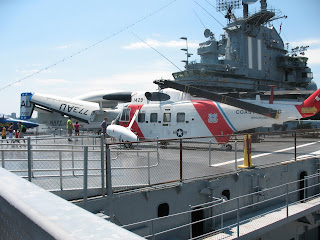
After buying the tickets, entering the museum and heading over to the elevator, nothing could have prepared me for the rush I felt when I stepped on the flight deck. Walking across a gangway, I got a clearer view of the aircraft exhibits. To my right was an F-16, an F-9 Cougar and right behind them was the venerable A-12, the granddaddy of the infamous SR-71 Blackbird. Across the deck there was an F-14, an A-6 and an F-11 Tiger. I won’t bore you to death listing the names of the various exhibits, though God knows I’d love to.

After exploring all the aircraft on the deck in detail, including a Marine Corps F-4 Phantom II that flew in Vietnam, I headed into the island superstructure. I could just imagine sailors scrambling around the tiny, cramped up interior, when the call for General Quarters was made. The ladders were angled slightly, and that proved an issue for me because of my height. I could have sworn I bumped my head at least 30 times climbing down the first set of ladders into the Admiral’s bridge. Finally, after I finished exploring the Island, I went below decks into the hangar bay. 

Good God almighty was it huge! There were a couple of simulators which I wound up trying out a little later, a bunch of space-related exhibits and a few helicopters.
Standing in front of a TBM Avenger, like the one Former President Bush flew in WWII, I was amazed by the gargantuan proportions of the aircraft. It was undoubtedly a death-dealing mass of raw power.

Seeing all this and more below the hangar deck, I made a definite decision that next summer, I’m going to check out the Hornet in California, the Lexington in Texas and Yorktown in South Carolina.

Folks, if you’re as obsessed with naval aviation as I am, I highly recommend you visit these ships. They serve as memorials to the brave sailors and Marines who fought on these ships throughout the Pacific, tearing a path of destruction throughout the Japanese naval armadas.