Showing posts with label fighter pilot. Show all posts

Wednesday, 24 October 2012

Thursday, 19 July 2012

The Missile with a Man In It.

Took a brief hiatus, but now I'm back.

Let's talk older fighter jets. Specifically, the F-104 Starfighter.

To anyone taking their first look at it, they'd probably think it's some weird invention out of Star Wars. Sleek, lengthy design, short and stubby wings... But, still something very curiously interesting. 46 years after the USAF brought it into service, the last Starfighter was retired in 2004 from the Italian Air Force. That's one hell of a long life.

The history behind the jet is chock-full of ups and downs. It was the brainchild of renowned Lockheed engineer Clarence "Kelly" Johnson, who designed it as a jet tailored to pilots. He visited and interviewed a number of fighter pilots about what they'd prefer in their aircraft and found that they were of the opinion that the Air Force's mainstay at the time, the F-86, was outclassed by the Soviet MiG-15s flown by the North Koreans. They just wanted a smaller, nimbler and speedier airframe. Johnson immediately got to work.


Initially, the XF-104 (experimental prototype) was shrouded in secrecy. The new aircraft was supposedly revolutionary, with an all new, much more powerful engine. It lacked something that was thought of as the convention for supersonic-capable jets: swept wings. Instead, it used a trapezoidal shape, determined by engineers at Lockheed to be ultra-efficient for high-speed fight. The wings were shortened, and extremely thin. In fact, the leading edges were razor-sharp. Ground crews had to install protective coverings over the wings before they went to work on the aircraft, lest they injure themselves by accident! The J79 engine was built to push the jet past Mach 2, which, at the time, made the Starfighter one of the fastest service aircraft in the world. Earlier models had a downward firing ejection seat. As some of you might've concluded, that wasn't a good decision at all, and sadly it resulted in the deaths of 21 pilots, before it was replaced with a more conventional seat.

The F-104, for all its hype, had a large number of dark moments in its history. Of all the Century Series fighters in USAF service, it had the highest accident rate. In fact, the Canadian air forces lost over 50% of their Starfighter fleet and the Germans lost 30%. Oddly enough, the Spanish air force didn't lose a single one!  Pilots soon bestowed newer nicknames on it, like "Lawn Dart" or "Flying Coffin".

Still, the F-104 proved itself time and time again, by breaking and setting multiple records and holding open the door for newer, better fighters to take the skies.


Iceman out.

Monday, 21 May 2012

100 years of Marine Corps Aviation

More like 100 years of kicking ass and taking names in the skies above some of the largest battles to every take place on the face of the earth.


100 years ago on the 22nd of May, 1912, a Marine 1st Lieutenant by the name of Alfred Austell Cunningham reported for flight-training to the Naval Academy where a training facility for aviators was set up. Thus, May 22nd was recognized as the birthday of Marine aviation.

In naval aviation, you'll hear of the exploits of Navy pilots and their daredevil stunts in the face of death. Lesser known are the accomplishments of their counterpart Marine pilots. Take for example Lt. Col. "Pappy" Boyington. That man had balls of steel. On one occasion, he and 24 fighters flew over a Japanese-occupied airfield (Kahili airdrome), during the Pacific campaign of WWII, taunting the guys on the ground into sending up a few planes. Turns out, the Japs weren't too happy with the sudden appearance of these Marines and sent up more fighters than the Black Sheep (Pappy's squadron) bargained for. In the ensuing battle, 20 Japanese pilots were shot down, forcing back their defensive force, while the Black Sheep returned home with not a single aircraft lost.

How about John Glenn... Marine fighter ace, first American to orbit the earth in 1962, US senator and the oldest human to fly into space in 1998? Or John Bolt, double-ace? Or, get this... TED WILLIAMS! Hell yeah, the legendary left-fielder for the Boston Red Sox was a decorated Marine fighter bomber in WWII and the Korean War!


Iceman and Maverick don't have s**t on the "Duke of Mukden"

Today, the Corps still flies their older F/A-18s, which will be replaced with the F-35s later on. They still fly their AV-8s (to be replaced by the STOVL F-35 variants) and their Sea Knights and Super Stallions. But the Air Wing's going through a major overhaul. Enter, the UH-1Y Venoms and the AH-1Z Vipers. Oh, and the super-awesome tiltrotor MV-22 Ospreys. This massive update will ensure that years from now, Marine aviation elements will still be relevant to America's war-fighting capabilities and will still be one of the leading forces at the tip of America's military spear.

Tuesday, 1 May 2012

Fighter Pilot Music!


What do you get when you give two F-16 pilots a guitar and a recording studio? Raunchy, mega-awesome fighter-pilot music!

Check out Dos Gringos on Youtube! They have a new album coming out this month.


Friday, 27 April 2012

The Original Aviator's Glasses

Ray-Ban's aviator sunglasses have held the market on lenses for pilots and aviation enthusiasts for years. Having owned a pair of Ray-Ban aviators, I can vouch for their quality, but if you want authenticity, history and durability, I'd strongly suggest you check out American Optical's Original Pilot or General sunglasses! Ultra-comfortable, extremely durable and downright badass, it's sure to give you good protection from the sun's rays and it'll definitely make the ladies swoon over you! Built for bomber pilots in WWII to military specifications, they were later adapted for use by fighter pilots and saw widespread popularity in the military and civilian aviation world.


Fact: American Optical's sunglasses were the first ever shades to land on the moon! Neil Armstrong, Buzz Aldrin and Michael Collins all had pairs and they now reside in the Smithsonian National Air and Space Museum in Washington DC. They were popular throughout NASA's Astronaut Corps.


Wednesday, 24 August 2011

Flattop

Some of the most beautiful warships to have come out of the Second World War were the Essex Class aircraft carriers. In all, 24 of these carriers (or flattops as they were nicknamed) were built for the Navy. Today, only four of the largest class of capital ships ever made remain as museum-ships; testaments to the military engineering might of the United States. The Hornet, Intrepid, Yorktown and Lexington are berthed as floating museums across the United States.


I had the opportunity to visit the USS Intrepid earlier this summer and explore what can be truly considered a marvel of engineering. On a hot Sunday in July (it was 100+), we trekked over to see the Intrepid, after getting off at the wrong subway station. Finally, after half an hour of blistering heat, chilidogs and stops to take in the view along the Hudson, the gigantic gray mass of the Intrepid became visible, and my heart started pounding. You see, my entire goal in life is to be a Naval Aviator. The problem is that everything is in my way. On an international level.  It’s hard to explain, so I won’t waste your time trying to. The thing is, I know I’ll accomplish my goals. So when I saw the carrier for the first time, I was overjoyed, because I could see a part of my future.
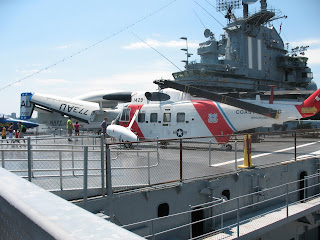
After buying the tickets, entering the museum and heading over to the elevator, nothing could have prepared me for the rush I felt when I stepped on the flight deck. Walking across a gangway, I got a clearer view of the aircraft exhibits. To my right was an F-16, an F-9 Cougar and right behind them was the venerable A-12, the granddaddy of the infamous SR-71 Blackbird. Across the deck there was an F-14, an A-6 and an F-11 Tiger. I won’t bore you to death listing the names of the various exhibits, though God knows I’d love to.

After exploring all the aircraft on the deck in detail, including a Marine Corps F-4 Phantom II that flew in Vietnam, I headed into the island superstructure. I could just imagine sailors scrambling around the tiny, cramped up interior, when the call for General Quarters was made. The ladders were angled slightly, and that proved an issue for me because of my height. I could have sworn I bumped my head at least 30 times climbing down the first set of ladders into the Admiral’s bridge. Finally, after I finished exploring the Island, I went below decks into the hangar bay. 

Good God almighty was it huge! There were a couple of simulators which I wound up trying out a little later, a bunch of space-related exhibits and a few helicopters.
Standing in front of a TBM Avenger, like the one Former President Bush flew in WWII, I was amazed by the gargantuan proportions of the aircraft. It was undoubtedly a death-dealing mass of raw power.

Seeing all this and more below the hangar deck, I made a definite decision that next summer, I’m going to check out the Hornet in California, the Lexington in Texas and Yorktown in South Carolina.

Folks, if you’re as obsessed with naval aviation as I am, I highly recommend you visit these ships. They serve as memorials to the brave sailors and Marines who fought on these ships throughout the Pacific, tearing a path of destruction throughout the Japanese naval armadas.